Time Windows and Leakage Safety
GraphReduce divides dated rows around a cutoff T:
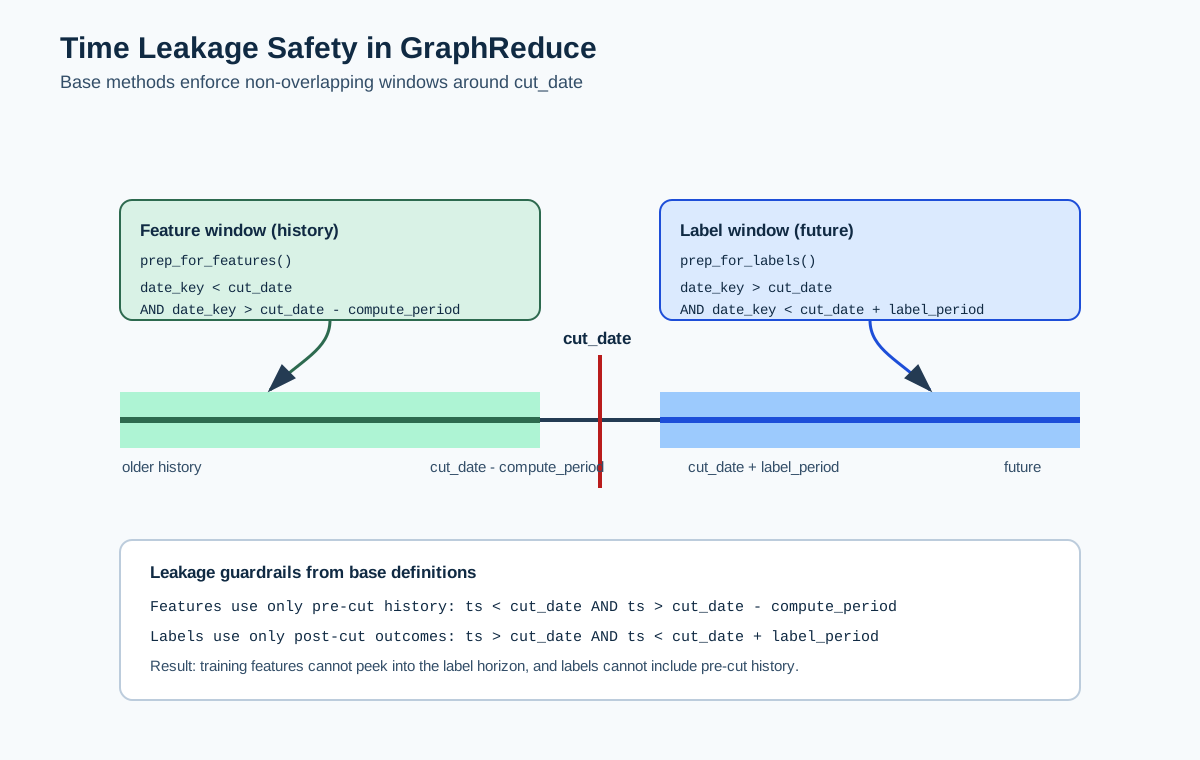
feature window                         label window
(T - compute period, T)                (T, T + label period)
──────────────────────●────────────────●──────────────────
          past                         T          future
For non-null timestamps, the base implementation uses strict comparisons. A
row exactly at T, at the history start, or at the label-window end is
excluded.
Configuration
| Setting | Meaning |
|---|---|
cut_date |
Point in time at which features are evaluated |
compute_period_val + compute_period_unit |
How far backward feature rows may extend |
label_period_val + label_period_unit |
How far forward label rows may extend |
Node date_key |
Timestamp column used to filter that node |
Graph-level values are pushed into nodes during graph hydration, keeping the cutoff and windows consistent across the graph.
Exact base-class contract
For a dated node, prep_for_features() applies:
prep_for_labels() applies:
Undated nodes are not filtered by these helpers. Set date_key on every node
whose rows become available over time.
The dataframe feature path currently retains rows whose configured date_key
is null, while SQL WHERE comparisons normally exclude them. Labels exclude
null timestamps. Decide whether unknown timestamps are valid for your problem,
and filter them explicitly when you need identical behavior across backends.
Example
With a cutoff of 2024-01-01, a 365-day compute period, and a 30-day label
period:
- features can use rows after
2023-01-01and before2024-01-01; - labels can use rows after
2024-01-01and before2024-01-31; and - a row stamped exactly
2024-01-01belongs to neither window.
Leakage checklist
- Use the timestamp that represents availability, not merely when a source event happened.
- Declare a
date_keyfor every time-varying node. - Confirm timezone and timestamp precision before comparing boundaries.
- Define and test a policy for null timestamps.
- Keep label-derived and future-derived fields out of the feature graph.
- Fit schema profiles and category selections using training data only.
- Inspect the minimum and maximum timestamps in a small materialized result.
- Build multiple cutoffs for backtesting instead of making a random row split across one temporal snapshot.
GraphReduce can enforce configured time boundaries, but it cannot infer when a business value truly became knowable. That remains part of the dataset's semantic contract.
See Point-in-time tutorial for an executable check.